
CHOOSING A PROGRAM
The Best Questions to Ask a Service Dog Trainer or Program
Choosing a service dog trainer can involve years of work and tens of thousands of dollars. A polished website, an official-looking badge, or a promise of certification does not prove that a trainer can safely prepare a dog for disability-related work.
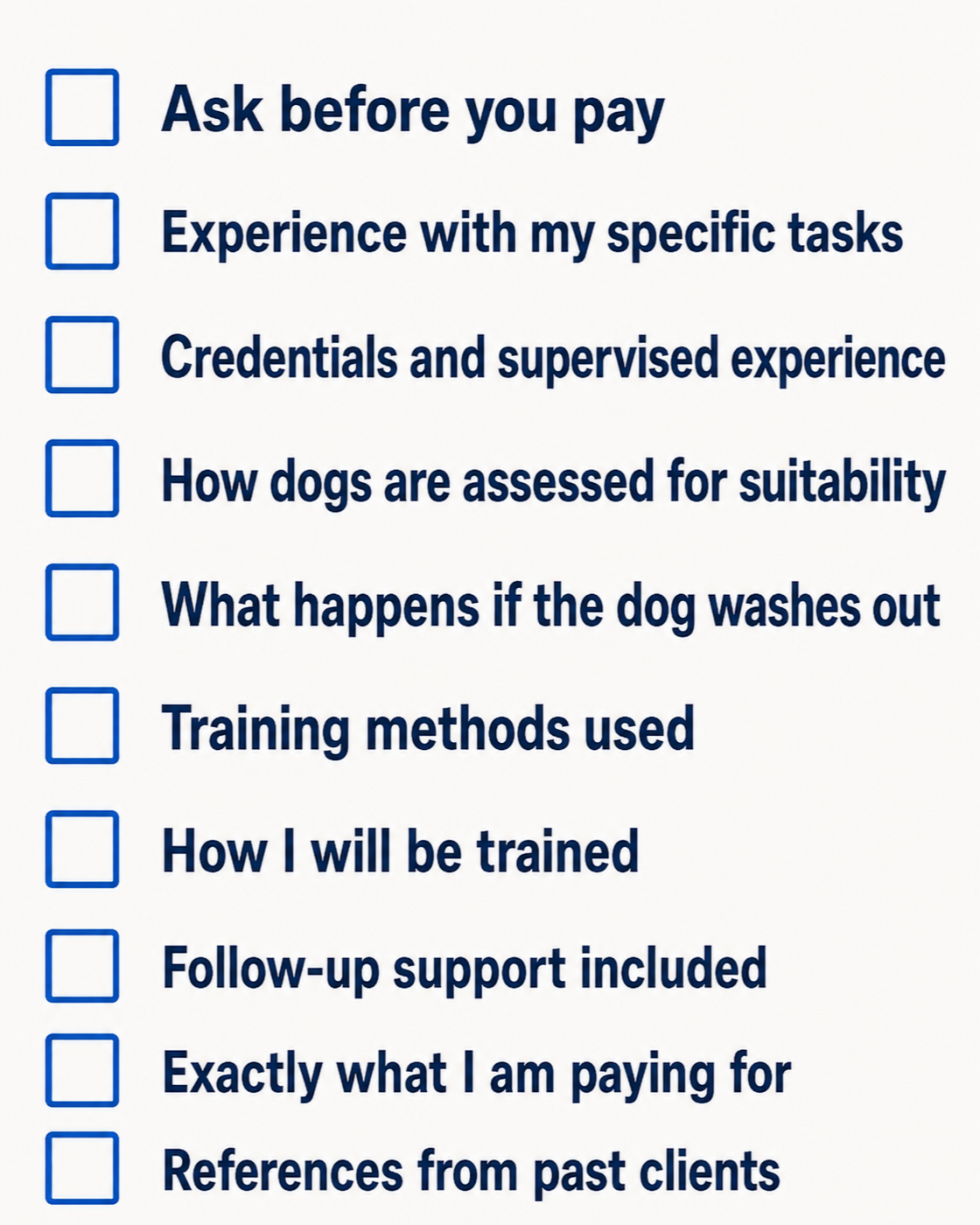
The goal is not simply to find someone who can teach obedience. A service dog professional must understand task training, public behavior, dog welfare, handler education, disability access, and the possibility that a dog may not be suitable for the job.
1. What is your experience with my specific disability and tasks?
Ask for concrete examples. Training a guide dog, a diabetic alert dog, a seizure response dog, and a psychiatric service dog require different knowledge.
Useful follow-up questions include:
- How many teams with similar needs have you trained?
- Which specific tasks have you trained successfully?
- How do you decide whether a proposed task is safe and useful?
- Will you communicate with my health care team if I authorize it?
- What outcomes do you track after placement?
A responsible trainer should distinguish a trainable response task from an alert that cannot be guaranteed.
2. What credentials, education, and supervised experience do you have?
The ADA does not require a trainer credential, but consumers still need a way to evaluate competence.
Ask about:
- Education in learning theory and humane training
- Apprenticeship or supervised service dog experience
- Experience assessing temperament and health
- Continuing education
- Professional memberships
- Accreditation held by the program
Assistance Dogs International accredits nonprofit assistance dog programs, not every private trainer or individual dog. The International Guide Dog Federation accredits guide dog organizations. Accreditation can be a strong quality indicator, but lack of accreditation is not automatic proof of incompetence. The trainer should still provide verifiable evidence of experience and transparent practices.
3. How do you evaluate whether a dog is suitable?
Not every good pet can become a service dog. Public work places unusual demands on a dog's emotional stability, health, recovery from stress, focus, and ability to ignore distractions.
Ask how the trainer evaluates:
- Fear and anxiety
- Aggression or resource guarding
- Startle recovery
- Sound and surface sensitivity
- Sociability without overexcitement
- Ability to settle quietly
- Health, structure, and stamina
- Motivation for the intended tasks
Ask who performs the veterinary assessment and whether breed, size, age, and physical structure are appropriate for the planned work.
4. What happens if the dog washes out?
A washout is a dog that does not continue in service work. Ethical programs expect that some dogs will not qualify.
The contract should explain:
- Who decides to remove a dog from training
- What behavioral or medical findings trigger that decision
- Whether another dog will be offered
- Which fees are refundable
- Who owns the dog
- Whether the handler may keep the dog as a pet
- How long the replacement process may take
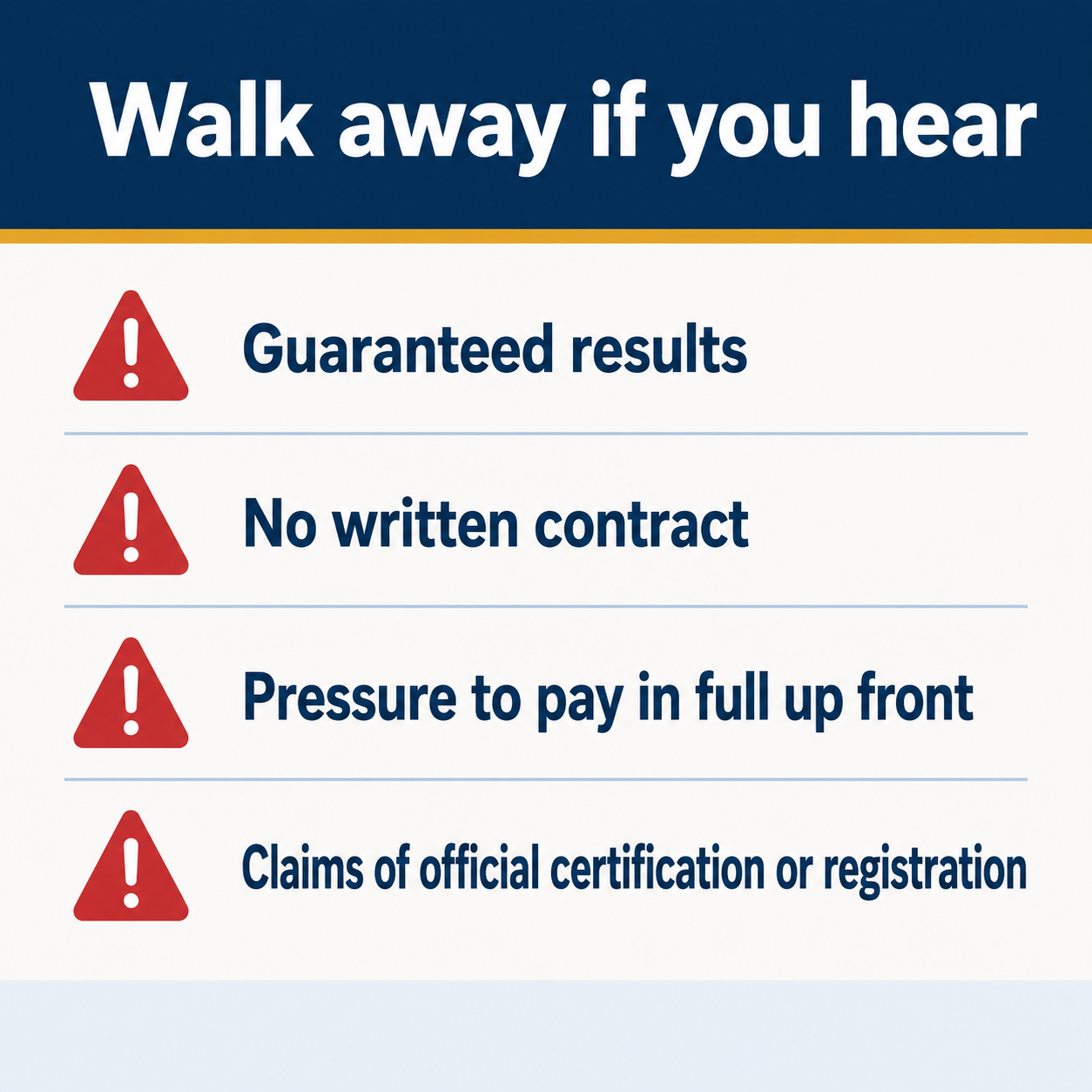
A guarantee that every dog will succeed is a red flag.
5. Which training methods do you use?
Ask the trainer to explain methods in plain language. Look for a structured plan that builds skills gradually, rewards desired behavior, protects welfare, and addresses fear without intimidation.
Ask:
- What equipment do you use and why?
- How do you respond when a dog makes a mistake?
- How do you prevent stress and burnout?
- Can I observe a lesson?
- How do you measure progress?
- What would cause you to change the training plan?
Avoid trainers who will not explain their methods or who rely on fear, flooding, pain, or physical force as routine tools.
6. How do you prepare the dog for public access?
Task performance alone is not enough. A working dog must be able to function unobtrusively and safely around crowds, food, carts, children, other dogs, transportation, medical equipment, and unexpected noise.
Ask whether training includes:
- Settling under a table
- Ignoring food and strangers
- Riding elevators and public transit
- Working around mobility devices
- Recovering from sudden sounds
- Maintaining position in lines and crowds
- Toileting on cue
- Entering and exiting vehicles safely
- Working in environments that match your real life
Ask what public-access assessment is used and what happens if the team is not ready.
7. How will you train me?
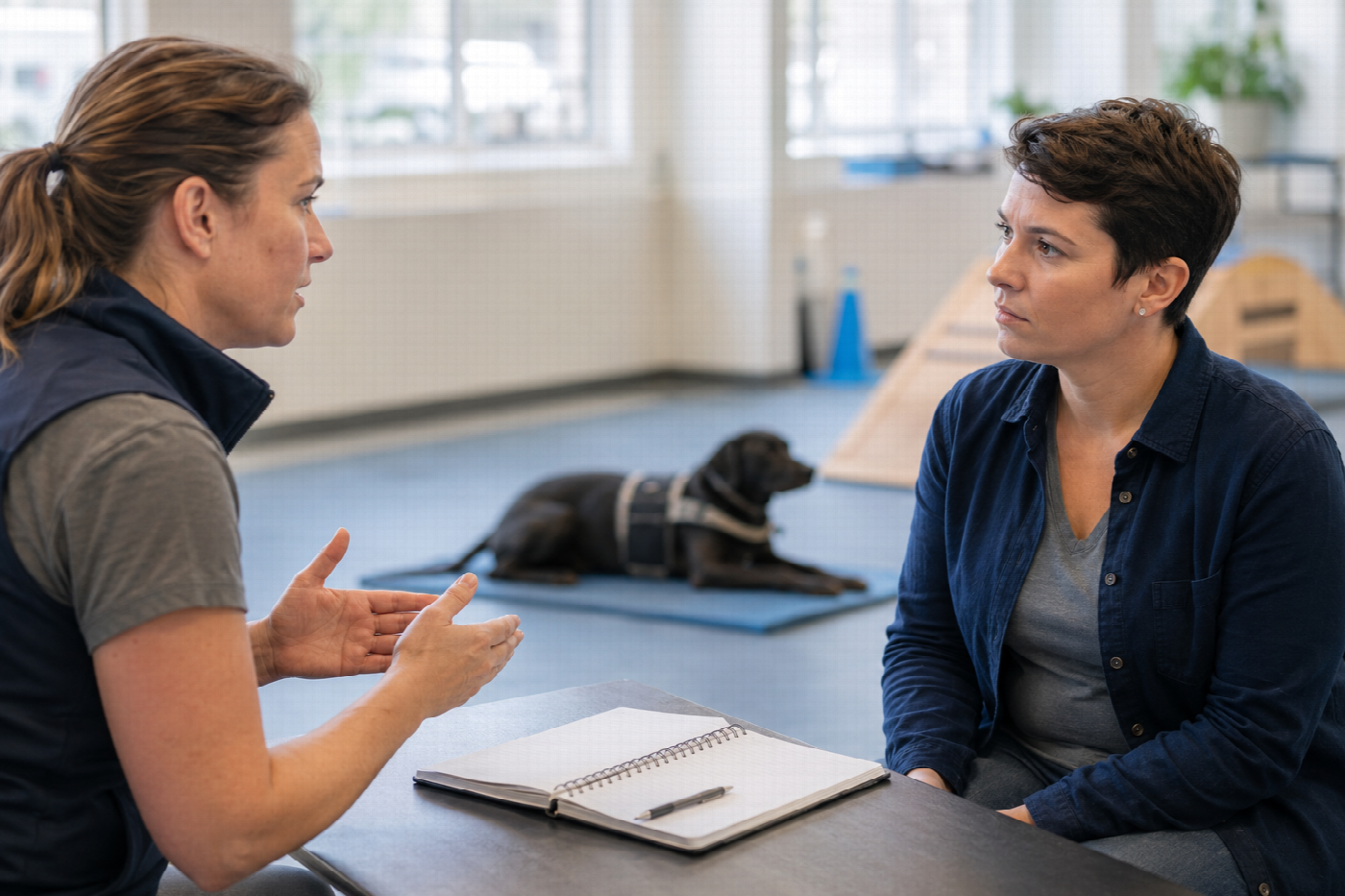
A service dog is part of a team. The handler must learn cues, reinforcement, grooming, veterinary care, access etiquette, problem solving, and maintenance training.
Ask:
- How many hours of handler instruction are included?
- Is instruction individual or group based?
- Will training occur in my home, school, or workplace?
- Can a family member or caregiver participate?
- What written and video materials are provided?
- How will you assess my ability to maintain the dog's skills?
Be cautious if the program focuses on delivering a finished dog with little handler education.
8. What follow-up support is included?
Skills can weaken. A person's disability or daily routine can change. Good programs plan for the life of the partnership.
Ask about:
- Scheduled follow-up visits
- Phone or video coaching
- Help after an access denial
- Retraining after illness or a major life change
- Behavioral support
- Retirement planning
- Emergency backup care
Get the support commitment in writing.
9. What exactly am I paying for?
Request an itemized explanation of application fees, assessments, training, travel, equipment, veterinary care, follow-up, and replacement policies.
Never rely on a verbal promise. Read the cancellation, refund, ownership, dispute, and fundraising provisions. Ask whether the program carries liability insurance and whether client funds are protected if the business closes.
Pressure to pay immediately, send money through an unusual method, or sign before reviewing the contract is a warning sign.
10. Can I speak with past clients?
Ask for references from teams with similar needs. Ask those clients:
- Did the final cost match the estimate?
- Was the timeline realistic?
- Did the dog perform the promised tasks?
- How did the trainer respond to problems?
- Was follow-up support available?
- Was the dog healthy and behaviorally stable?
Online reviews are useful but can be manipulated. References, public records, accreditation status, and direct observation provide a stronger picture.
11. What claims do you refuse to make?
This question is surprisingly revealing. Ethical trainers should acknowledge limits.
Examples:
- Seizure prediction cannot be guaranteed.
- Glucose alerts vary and should not replace medical technology.
- A trainer cannot guarantee lifetime public access regardless of behavior.
- A service dog is not appropriate for every person.
- A certificate does not create legal status.
Red flags to take seriously
Walk away or investigate further if a trainer:
- Guarantees a fully trained dog in a few days
- Sells registration as the source of legal rights
- Promises every dog will succeed
- Refuses to disclose training methods
- Cannot explain task training for your disability
- Discourages veterinary or medical input
- Has no washout or replacement policy
- Requires large nonrefundable payments without a detailed contract
- Will not let you observe training or speak with clients
- Claims a dog can replace medical treatment or monitoring
Sources
- Assistance Dogs International: Looking for an Assistance Dog
- Assistance Dogs International: Member Search
- International Guide Dog Federation Standards
- International Guide Dog Federation: What Accreditation Means
- U.S. Department of Justice: Service Animal FAQs
- IAADP Minimum Training Standards
No credential or accreditation replaces careful consumer review. Verify claims directly with the organization that issued the credential.