
LAWS AND RIGHTS
Service Animal Laws in the United States: A Practical Guide
Service animal law becomes confusing when people treat one legal rule as if it applies everywhere. It does not. A restaurant, an apartment complex, an employer, and an airline may all be required to apply different standards to the same person and dog.
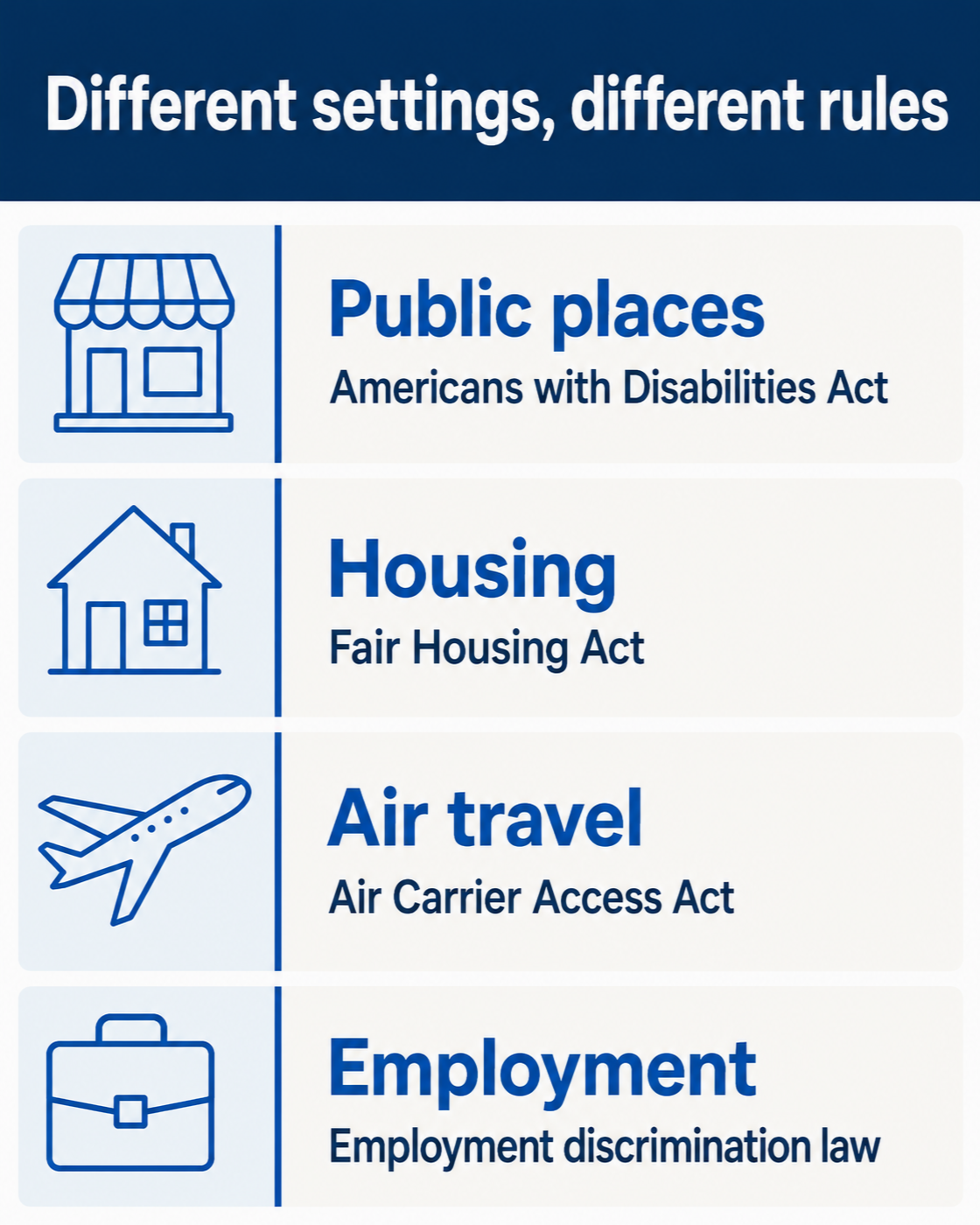
The safest way to understand the law is to start with the setting. The Americans with Disabilities Act governs most public businesses and state and local government programs. The Fair Housing Act governs many housing situations. The Air Carrier Access Act governs commercial air travel. Employment requests are generally evaluated under employment discrimination law. State laws may add protections or penalties, but they cannot take away rights guaranteed by federal law.
What legally makes a dog a service animal?
Under Titles II and III of the Americans with Disabilities Act, a service animal is a dog that has been individually trained to do work or perform tasks for a person with a disability. The work must be directly related to the person's disability.
Examples include:
- Guiding a person who is blind
- Alerting a person who is deaf to sounds
- Retrieving medication or a phone
- Interrupting a dissociative episode
- Alerting to a change in blood glucose
- Getting another person during a seizure
- Providing balance or mobility assistance
Comfort, companionship, and a calming presence are valuable, but they are not trained tasks under the ADA. A dog whose presence provides emotional support without performing trained disability-related work is not an ADA service animal.
The ADA does not require professional training, certification, registration, a special vest, or a clinician's letter. A person with a disability may train a service dog. The dog must still be trained for disability-related work and must behave appropriately in public.
Public access under the ADA
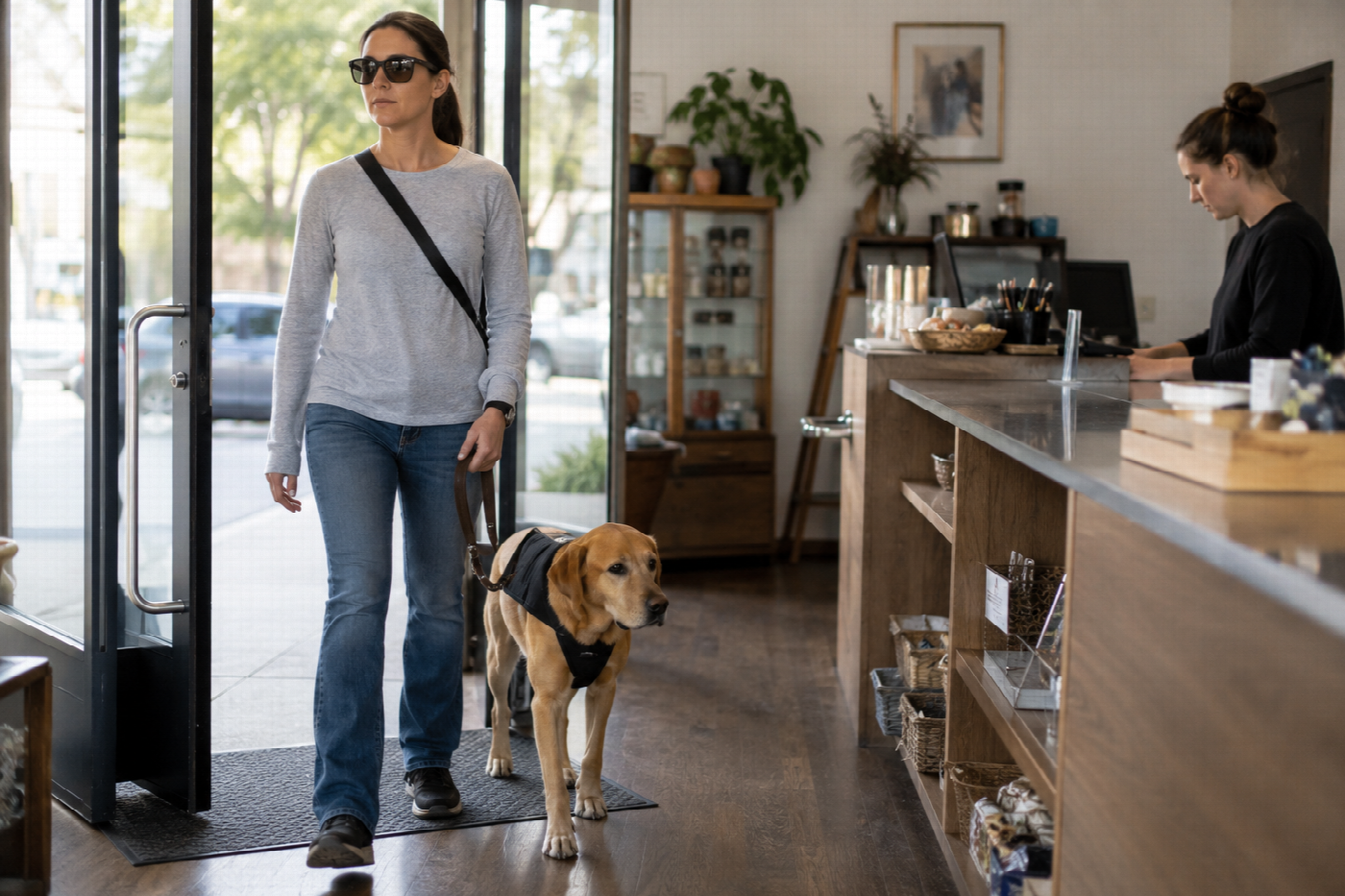
Businesses and state or local government programs generally must allow a service dog to accompany its handler anywhere members of the public are normally allowed to go. This includes most restaurants, stores, hotels, theaters, clinics, and government offices.
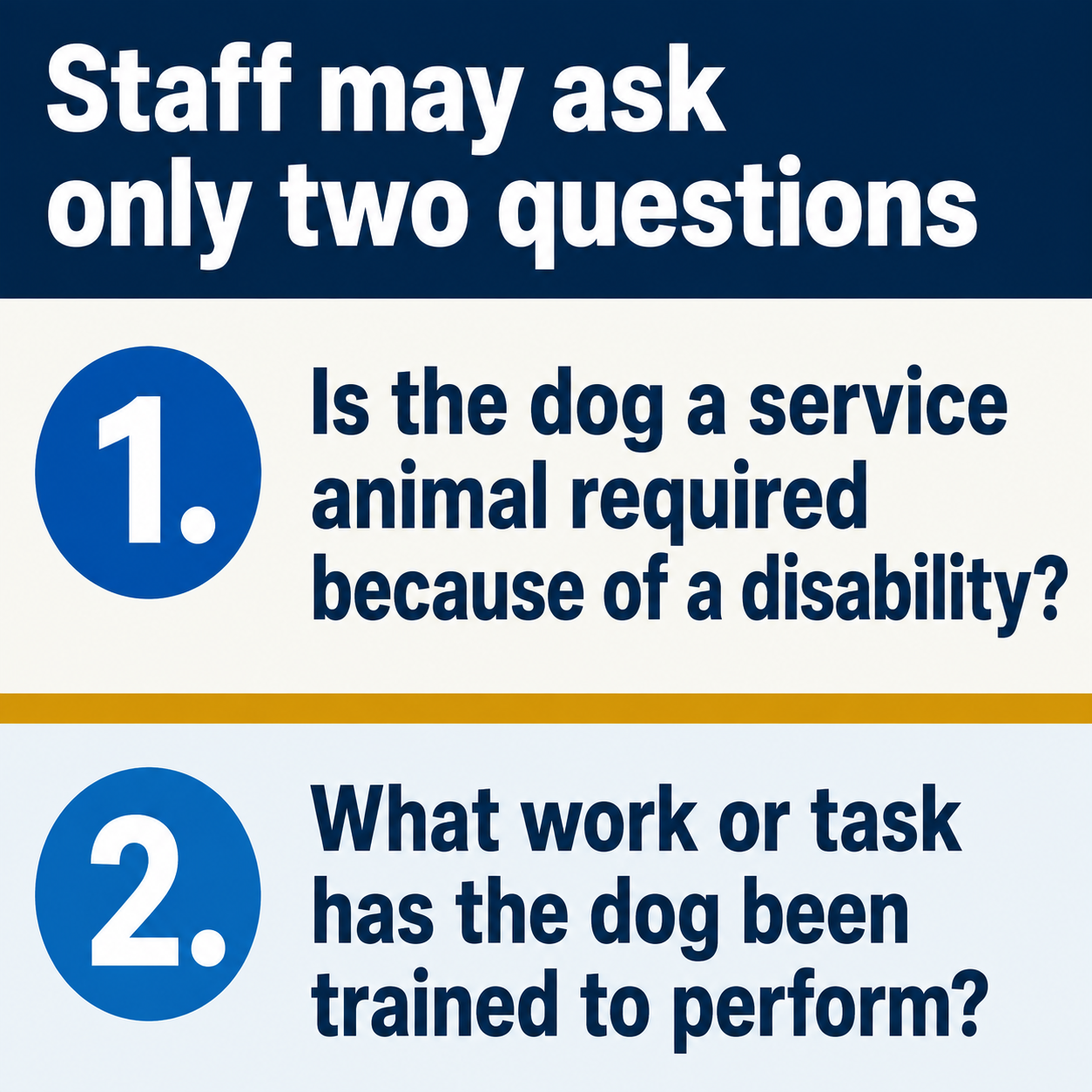
When the dog's function is not obvious, staff may ask only:
- Is the dog a service animal required because of a disability?
- What work or task has the dog been trained to perform?
Staff may not demand the person's diagnosis, medical records, a service dog certificate, proof of training, or a demonstration of the task.
The handler must keep the dog under control. A dog may be excluded if it is not housebroken or if it is out of control and the handler does not take effective action. A particular dog may also be excluded when its presence would create a direct threat or fundamentally alter the nature of a program. General fear, allergies, breed stereotypes, and a no-pets rule are not enough by themselves.
Housing rules are different
Housing law uses the broader term assistance animal. Depending on the law that applies, this can include a task-trained service animal and may include an animal that provides disability-related emotional support.
The Fair Housing Act requires covered housing providers to consider reasonable accommodation requests that are necessary for a person with a disability to use and enjoy a dwelling. A request might involve an exception to a no-pets rule, a pet fee, or another animal policy.
Federal housing policy is currently in transition. On May 22, 2026, HUD's Office of Fair Housing and Equal Opportunity announced that it would find reasonable cause in animal accommodation cases only when the animal is trained to perform disability-related work or tasks. That enforcement decision does not rewrite the text of the Fair Housing Act, erase existing court decisions, or eliminate stronger state protections. It does mean that consumers and housing providers should not rely on older summaries that describe every ESA request as automatically protected.
California is an important example. In July 2026, the California Civil Rights Department reaffirmed that California housing law continues to require reasonable accommodations for qualifying emotional support animals.
Air travel has its own definition
Under current Department of Transportation rules, airlines must recognize a dog that is individually trained to do work or perform tasks for a qualified passenger with a disability. Psychiatric service dogs are treated the same as other service dogs.
Airlines are not required to treat emotional support animals, comfort animals, other species, or service dogs in training as service animals. An airline may require the DOT Service Animal Air Transportation Form. For a flight lasting eight hours or more, it may also require the DOT relief attestation form.
What about employment?
The ADA rules for public businesses are not the same as the employment rules in Title I. An employee may request an animal as a reasonable accommodation. The employer may request appropriate information when the disability or need is not obvious and may assess effectiveness, safety, and workplace impact.
The animal does not necessarily have to meet the public-access definition in every employment case. The question is whether the requested accommodation is reasonable and enables the employee to perform the job or enjoy equal workplace benefits without imposing an undue hardship or direct threat.
What state laws can add
States commonly regulate:
- Access for service dogs in training
- Penalties for injuring or interfering with a service dog
- Fraudulent representation of a pet as a service animal
- Service dog licensing fee exemptions
- White cane and guide dog traffic protections
- Housing documentation and health professional conduct
State laws vary. Many states protect service dogs in training even though the federal ADA does not. Some states also impose penalties on people or businesses that sell misleading service animal identification.
Does a therapist's letter create legal status?
No. A licensed therapist may document a disability-related need for a housing or workplace accommodation when it is clinically appropriate. That letter does not train a dog, certify a dog, create ADA public-access rights, or guarantee approval.
A legitimate letter should be based on an individualized clinical evaluation and should stay within the professional's legal scope. Clinicians must also follow licensing and telehealth rules where the client is located.
The practical rule
Ask four questions:
- What setting is involved?
- Which federal law governs that setting?
- Is the animal trained to perform disability-related work?
- Does state or local law provide additional protection?
That approach is more accurate than relying on a vest, an online registration, or a generic statement that an animal is permitted everywhere.
Frequently asked questions
Can a business require a service dog certificate?
No. The Department of Justice does not recognize online service dog certificates as proof of ADA status.
Can a landlord charge for damage?
Yes. Assistance animal status does not remove responsibility for actual damage caused by the animal.
Are service dogs exempt from vaccination and ordinary dog licensing?
No. Generally applicable vaccination and dog licensing rules still apply. A government may not require special service animal registration as a condition of public access.
Are emotional support animals allowed in restaurants?
Not under the federal ADA. A restaurant may choose to admit a pet, but an ESA letter does not create a public-access right.
Sources
- U.S. Department of Justice: ADA Requirements for Service Animals
- U.S. Department of Justice: Service Animal FAQs
- HUD: May 22, 2026 Animal Accommodation Enforcement Guidance
- U.S. Department of Transportation: Service Animals
- Michigan State University: 50-State Assistance Animal Laws
This article provides general legal information, not legal advice. Laws, enforcement policies, and individual circumstances can change the result.