
LAWS AND RIGHTS
What the ADA Says About Service Animals
The Americans with Disabilities Act is the main federal law governing service animal access in state and local government services and most businesses open to the public. Its rule is narrower and more practical than many online explanations suggest.
The ADA focuses on three things: disability, training, and the connection between the two.
The ADA definition
Under Titles II and III, a service animal is a dog that is individually trained to do work or perform tasks for a person with a disability. The task must be directly related to the disability.
The ADA definition includes physical, sensory, psychiatric, intellectual, and other mental disabilities. A psychiatric service dog is not a lesser category. If the dog performs trained work related to a psychiatric disability, it is a service dog.
Examples from Department of Justice guidance include guiding a person who is blind, alerting a person who is deaf, pulling a wheelchair, assisting during a seizure, reminding a person to take medication, and taking a trained action during a PTSD anxiety attack.
Emotional support is not an ADA task
A dog may provide deep emotional benefit and still not qualify under the ADA. The distinction is whether the dog has been trained to take a specific action that helps with the disability.
For example:
- A dog's presence makes a person feel safer: emotional support.
- A dog is trained to interrupt escalating self-harm behavior: service work.
- A dog cuddles with a person after a nightmare: emotional support.
- A dog is trained to recognize movement associated with a nightmare and wake the handler: service work.
The same dog can provide companionship in addition to trained tasks. The legal status comes from the trained disability-related work.
No federal certification or registration
The ADA does not require:
- Professional service dog training
- A national certification
- An online registration
- A government ID card
- A service dog vest
- A therapist's letter for public access
The Department of Justice specifically warns that documents sold online do not convey ADA rights. A city may require ordinary dog licensing and vaccination, but it may not require special service animal registration as a condition of public access.
The two questions businesses may ask
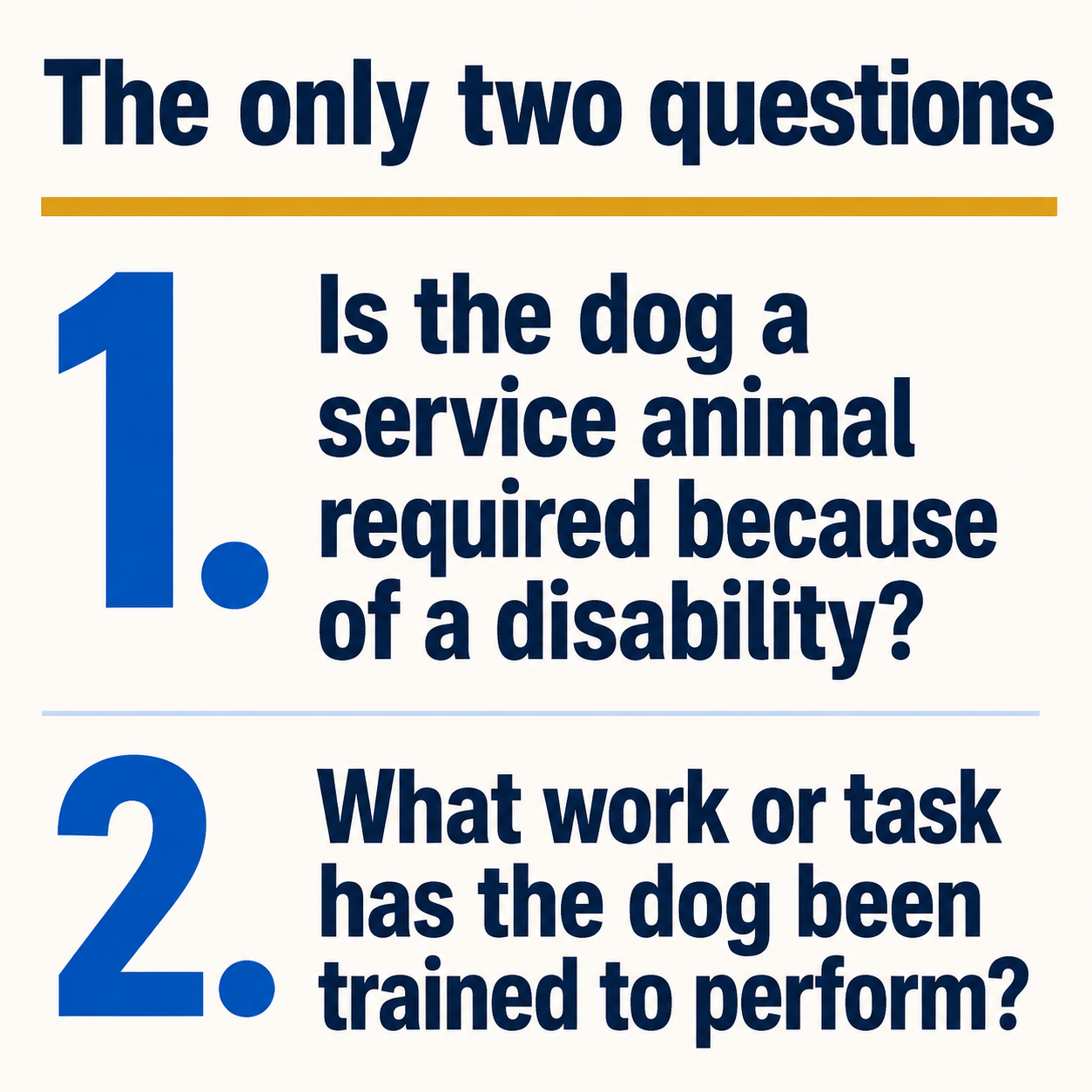
When the dog's purpose is not obvious, staff may ask:
- Is the dog a service animal required because of a disability?
- What work or task has the dog been trained to perform?
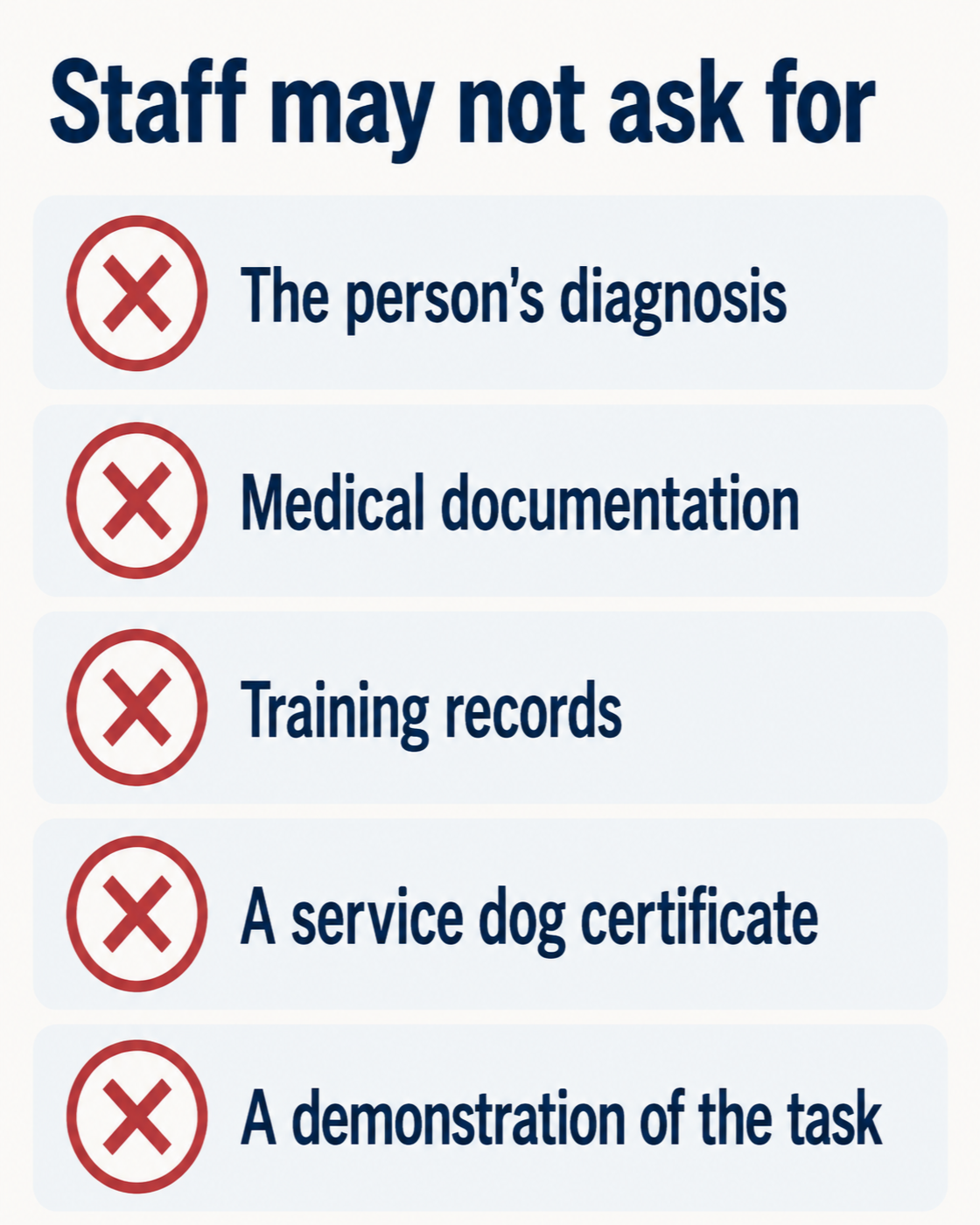
Staff may not ask for the diagnosis, demand medical documentation, require training records, insist on a certificate, or ask the dog to demonstrate its task.
The handler does not have to provide a detailed medical history. The handler does need to identify trained work that is related to a disability. Saying only that the dog provides comfort does not describe an ADA task.
Where the dog is allowed
A qualifying service dog generally may accompany the handler in all areas where customers, program participants, or members of the public are allowed.
Examples include:
- Dining rooms and food service lines
- Retail stores
- Hotel rooms
- Theaters
- Public transportation
- Government offices
- Hospital patient rooms and clinics
Access is not unlimited. A dog may be excluded from a sterile operating room or another area where its presence would compromise a legitimate safety requirement. A zoo may restrict a dog from a specific area where its presence would disrupt animals that are natural predators or prey while still allowing the team in other areas.
Control and behavior requirements
The dog must be under the handler's control. It should generally be harnessed, leashed, or tethered. If the equipment would interfere with the dog's work or cannot be used because of the handler's disability, the handler must use voice, signals, or another effective method of control.
A business may ask for removal if:
- The dog is out of control and the handler does not correct it.
- The dog is not housebroken.
- The particular dog poses a direct threat based on its actual behavior or history.
- The dog's presence would fundamentally alter the service or program.
If the dog is properly removed, the business must still offer the person an opportunity to obtain its goods or services without the dog.
Fees, deposits, and damage
A business cannot impose a pet fee, pet deposit, or special cleaning charge because a person uses a service dog. A hotel cannot restrict the person to a pet-friendly room.
The business may charge for actual damage if it normally charges other customers for similar damage. Service animal status is not immunity from responsibility.
Allergies and fear of dogs
Allergies and fear are not automatic reasons to deny access. The covered entity should try to accommodate both people, such as placing them in different parts of a room when feasible.
Breed stereotypes are also insufficient. A service dog cannot be excluded merely because of its breed. Any direct-threat decision must be based on the particular dog.
Service dogs in training
The federal ADA protects dogs that are already trained. It does not create public-access rights for service dogs in training. Many states provide separate access rights to qualified trainers or handlers, so state law must be checked.
Miniature horses
The ADA has a separate provision for miniature horses trained to perform disability-related work. A covered entity must make reasonable modifications when appropriate, considering whether the horse is housebroken, under control, compatible with the facility's size and weight limits, and consistent with legitimate safety requirements.
What the ADA does not govern
The public-access provisions do not answer every animal question. Housing may be governed by the Fair Housing Act and state law. Commercial flights are governed by the Air Carrier Access Act. Employment requests are evaluated under workplace accommodation rules.
Frequently asked questions
Can staff ask what the person's disability is?
No. Staff may ask the two permitted questions when the dog's role is not obvious, but they may not demand the diagnosis.
Must a service dog be perfectly silent?
No, but the dog must remain under control. A single bark may be part of a trained alert. Repeated uncontrolled barking may justify removal if the handler does not correct it.
Can a service dog sit on a restaurant chair?
The ADA provides access to the premises, not a right for the dog to use customer seating or eat from the table.
Can two service dogs accompany one person?
Sometimes. A person may use different dogs for different tasks. Both should be admitted when they can be accommodated safely without blocking aisles or creating another legitimate problem.
Sources
- U.S. Department of Justice: ADA Requirements for Service Animals
- U.S. Department of Justice: Frequently Asked Questions About Service Animals
- ADA Title II Regulations
- ADA Title III Regulations
This article provides general legal information, not legal advice.