
LAWS AND RIGHTS
Why California Service Animal and ESA Laws Are Different
California is different for two main reasons. First, it has several state civil rights laws that operate alongside federal disability law. Second, it directly regulates health professionals who provide documentation concerning an emotional support dog.
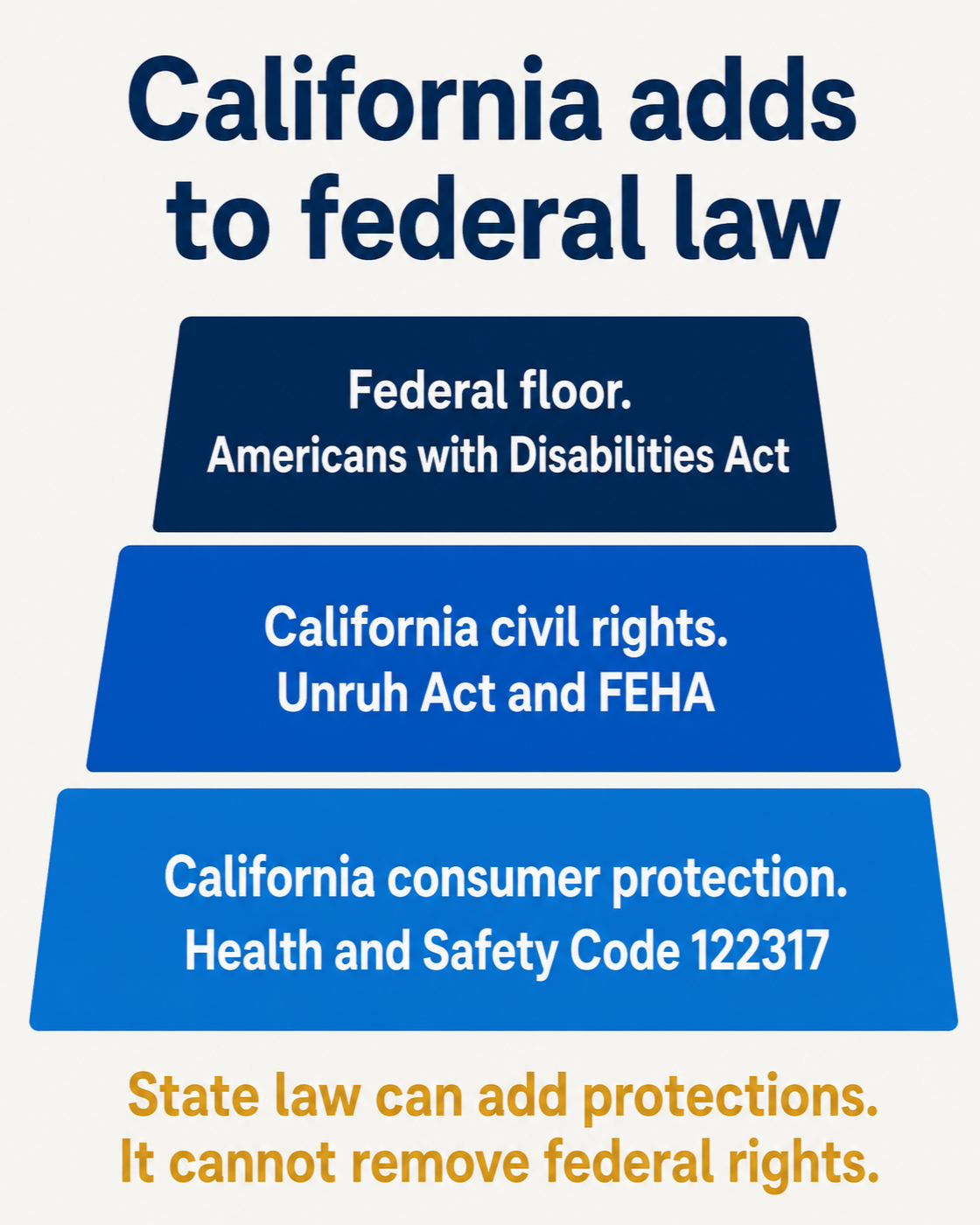
California did not turn emotional support animals into public-access service animals. Restaurants, stores, hotels, and other public businesses generally do not have to admit an ESA. California's distinctive rules are strongest in housing, employment, state-funded programs, service dogs in training, and the regulation of ESA documentation.
California uses several overlapping laws
California service animal rights may involve:
- The federal Americans with Disabilities Act
- The federal Fair Housing Act
- Section 504 of the Rehabilitation Act
- The California Fair Employment and Housing Act
- The California Disabled Persons Act
- The Unruh Civil Rights Act
- California Government Code section 11135
- California Health and Safety Code sections governing emotional support dog documentation
- California Penal Code provisions addressing fraudulent service dog claims
The setting still matters. A dog may qualify under one legal framework but not another.
Public access in California
The federal ADA generally requires public businesses and state or local government entities to allow a dog that is individually trained to perform disability-related work. California law also protects qualifying guide, signal, and service dogs.
The core requirements remain familiar:
- The handler must have a disability.
- The dog must be trained for work or tasks related to that disability.
- Emotional comfort by itself is not a trained task.
- The dog must remain under control and be housebroken.
- No online registration, ID card, or vest creates legal status.
California can provide remedies through state civil rights law when a business unlawfully denies access. The exact claim and remedy depend on the facts, so an individual facing a denial may need advice from a disability rights organization or attorney.
California housing law protects support animals
California's Fair Employment and Housing Act uses the broader concept of an assistance animal in housing. California regulations distinguish service animals that perform trained tasks from support animals that provide emotional, cognitive, or similar support to a person with a disability.
On July 20, 2026, the California Civil Rights Department issued a legal alert after HUD changed its federal enforcement approach. California reaffirmed that state law continues to require housing providers to grant reasonable exceptions when needed to give a person with a disability an equal opportunity to use and enjoy housing. Potential accommodations include waiving no-pets policies, pet fees, and breed restrictions.
This is one of the clearest reasons California is currently unique. Federal HUD enforcement became narrower in May 2026, but California publicly reaffirmed its broader state protection for qualifying ESAs two months later.
Protection is not automatic. The person must have a qualifying disability, there must be a disability-related need for the animal, and the accommodation must be reasonable. A housing provider may seek reliable information when the disability or need is not apparent. The resident remains responsible for control, sanitation, safety, and actual damage.
The California 30-day ESA documentation rule
California Health and Safety Code section 122318 regulates a health care practitioner who provides documentation concerning a person's need for an emotional support dog.
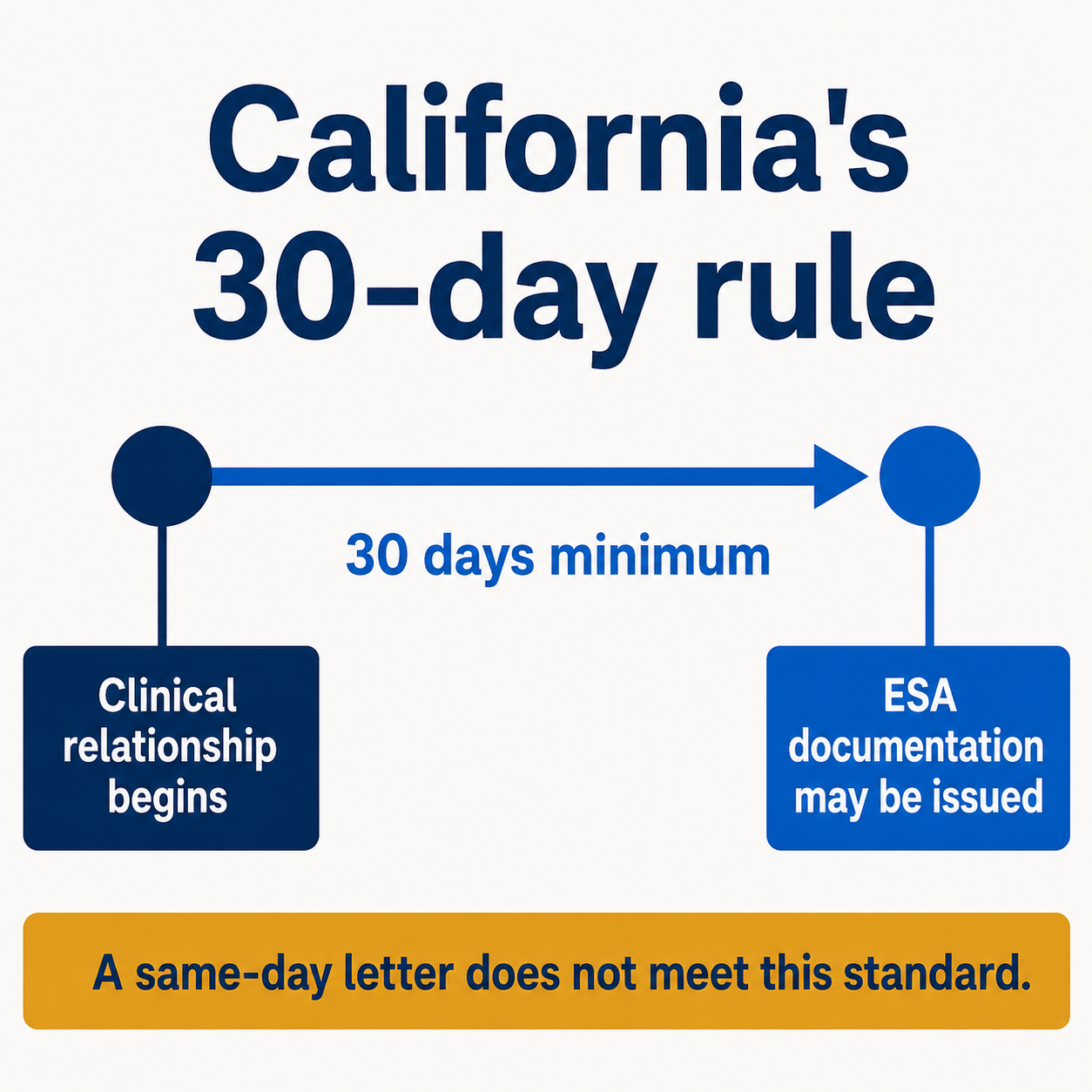
The practitioner must:
- Hold a valid, active professional license.
- Include the license type, number, jurisdiction, and effective date in the documentation.
- Be licensed in the jurisdiction where the documentation is provided.
- Establish a client-provider relationship for at least 30 days before issuing the documentation.
- Complete a clinical evaluation concerning the need for the emotional support dog.
- Provide verbal or written notice that knowingly and fraudulently representing a dog as a guide, signal, or service dog is a misdemeanor.
The law does not specify a minimum number of sessions. It requires the relationship to exist for at least 30 days and requires a clinical evaluation.
What the 30-day rule does not do
The rule does not:
- Make an ESA a service dog
- Grant access to restaurants or stores
- Guarantee that a housing request will be approved
- Create airline rights
- Require a health professional to write a letter
- Permit a clinician to practice across state lines without appropriate authority
It regulates professional documentation. California expressly stated that AB 468 did not restrict existing fair housing rights.
Service dogs in training
The federal ADA does not grant public access to a dog that is still in training. California law provides access protections for qualifying trainers and dogs in training in circumstances defined by state law. This is another area where state protection can be broader than the federal baseline.
A person should not assume that every puppy wearing a service dog vest has unrestricted access. The handler and training situation must meet California's requirements, and the dog must be under control.
Fraud and misleading products
California makes it a misdemeanor to knowingly and fraudulently represent oneself as the owner or trainer of a dog that is qualified or identified as a guide, signal, or service dog.
California also requires sellers of emotional support dog certificates, tags, vests, leashes, or harnesses to provide notices explaining that the items do not qualify the dog as a service dog and do not create public-access rights.
This matters because a product can look official without having legal value. A laminated card, registration number, or vest purchased online cannot replace disability-related task training.

Employment is broader than public access
California employment regulations recognize assistive animals as a possible reasonable accommodation. Depending on the facts, this can include a task-trained animal or a support animal. Employers may engage in an interactive process and evaluate the need, effectiveness, conduct, and workplace impact.
The public-access rule should not be copied into an employment decision. Employment accommodations are individualized.
Air travel does not change at the California border
Commercial air travel is governed primarily by the federal Air Carrier Access Act and Department of Transportation rules. Airlines must recognize qualifying task-trained service dogs. They are not required to recognize ESAs as service animals.
California's ESA documentation rule does not require an airline to accept an ESA in the cabin without applying its ordinary pet policy.
What a California-compliant website should say
A site offering clinician evaluations should make clear that:
- Documentation is provided only when clinically appropriate.
- The clinician must be legally authorized to serve the client where the client is located.
- California emotional support dog documentation cannot be issued before the 30-day relationship requirement is satisfied.
- A letter supports a housing accommodation request and does not guarantee the result.
- The site does not sell service dog certification or public-access rights.
Anything suggesting instant California ESA approval creates obvious legal and ethical risk.
Frequently asked questions
Does California require an ESA certificate?
No. An online certificate or registration does not establish disability or disability-related need by itself.
Does the 30-day rule apply to every animal?
Section 122318 specifically addresses documentation concerning an emotional support dog. Other accommodation and professional practice rules may still apply to other animals.
Can a California landlord require the tenant's diagnosis?
Generally, the tenant should not have to provide unnecessary diagnostic details. When the disability or need is not apparent, the provider may request reliable information sufficient to evaluate the accommodation.
Can an ESA go into a California grocery store?
Not as a matter of ESA status. Only a qualifying service dog has the general public-access protection applicable to grocery stores.
Sources
- California Department of Justice: Service Animals
- California Civil Rights Department: July 20, 2026 ESA Housing Alert
- California Civil Rights Department: Emotional Support Animals and Fair Housing Law
- California Board of Psychology: AB 468 Requirements
This article provides general legal information, not legal advice. California law and professional licensing rules should be checked for updates before acting.