
LAWS AND RIGHTS
What HUD Says About Assistance Animals in Housing
Housing is the area of assistance animal law that changed most recently. Older web pages often say that HUD treats every qualifying emotional support animal like a task-trained service animal. That was HUD's longstanding guidance, but it is no longer a complete description of federal enforcement policy.
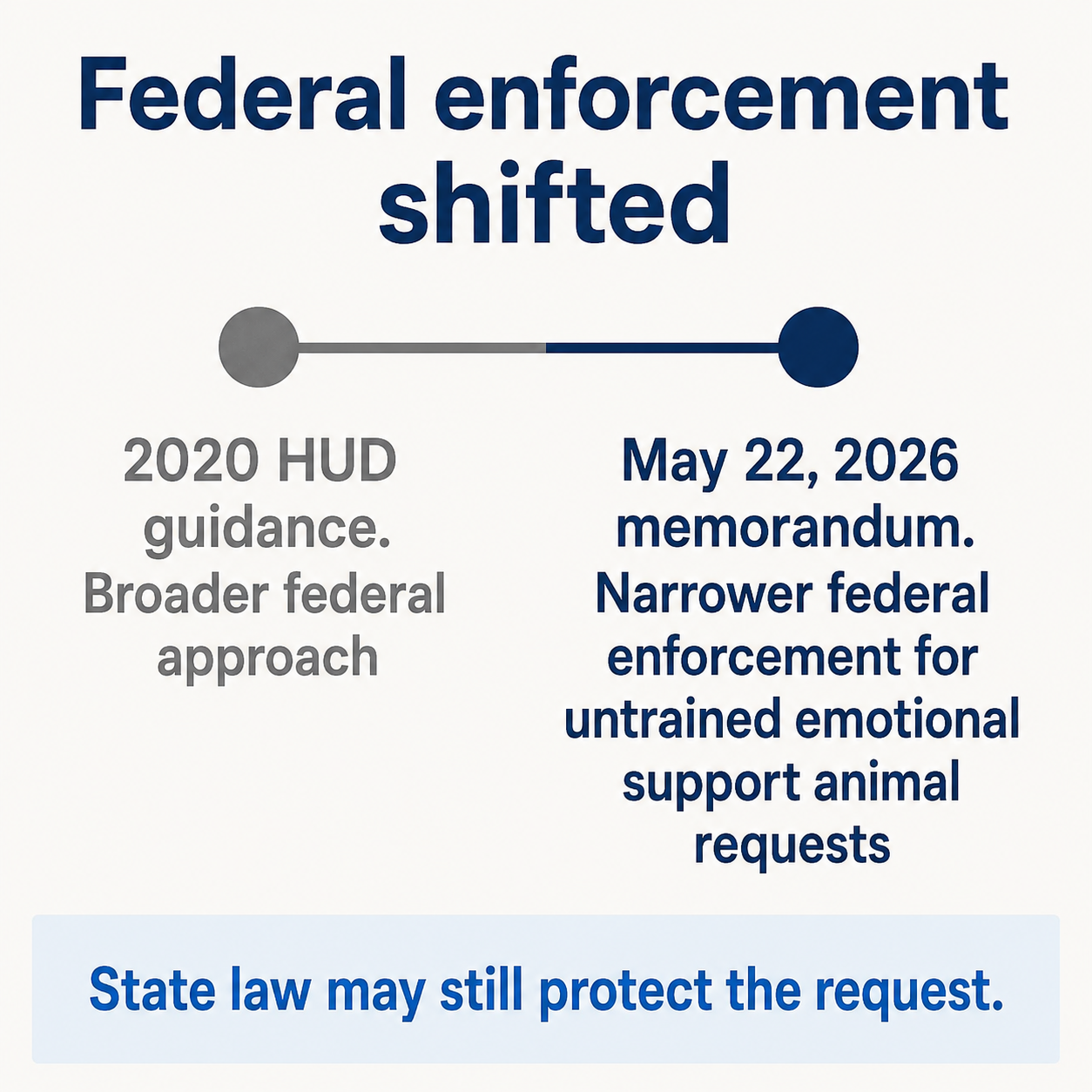
On May 22, 2026, HUD's Office of Fair Housing and Equal Opportunity announced a narrower enforcement approach. For complaints involving animal-related accommodations under the Fair Housing Act, the office said it would find reasonable cause and recommend charges only when the animal is trained to provide disability-related assistance.
That is a major policy change. It requires careful explanation because an enforcement memorandum is not the same thing as Congress amending a statute.
What the Fair Housing Act says
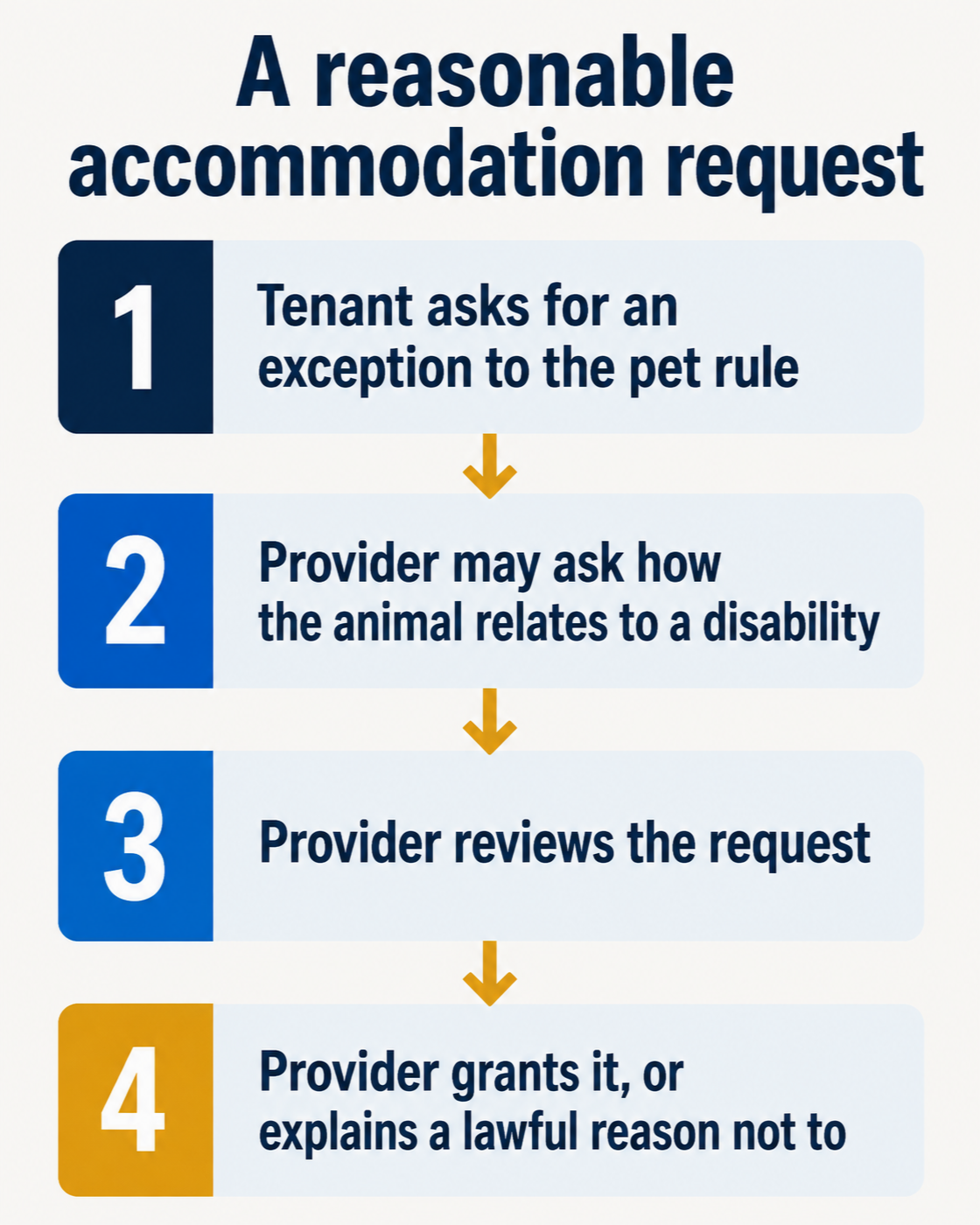
The Fair Housing Act prohibits covered housing providers from discriminating because of disability. Discrimination can include refusing to make a reasonable accommodation in a rule, policy, practice, or service when the accommodation may be necessary to give a person with a disability an equal opportunity to use and enjoy a dwelling.
An animal request is one application of that broader reasonable accommodation duty. The legal questions typically include:
- Does the person have a qualifying disability?
- Is the requested accommodation necessary for equal use and enjoyment of the housing?
- Is there a connection between the disability and the animal's assistance?
- Is the request reasonable under the circumstances?
The law does not create a general right to keep any animal in any property without review.
HUD's earlier approach
For years, HUD guidance distinguished:
- Service animals that meet the ADA task-training definition.
- Other assistance animals that perform work, provide assistance, or provide therapeutic emotional support.
Under that approach, a qualifying ESA could be treated as an assistance animal rather than a pet. Housing providers were generally instructed to consider exceptions to no-pets rules and not to impose pet fees or deposits for approved assistance animals.
HUD's public Housing Choice Voucher page still describes ESAs as protected and says appropriate health care documentation may verify the need. Consumers should understand that HUD's current web materials are not fully aligned with its May 2026 enforcement memorandum.
The May 22, 2026 enforcement change
The new memorandum states that FHEO will use the training component of the ADA service animal definition when assessing Fair Housing Act animal complaints. It says:
- Complaints involving task-trained animals will receive enforcement priority.
- Requests involving trained disability-related work are presumptively reasonable.
- Requests involving untrained ESAs are not presumptively reasonable.
- FHEO no longer expects housing providers categorically to extend the same accommodation rules to untrained ESAs.
The memorandum also rescinds the 2020 assistance animal notice as an enforcement guide.
What the memorandum does not settle
The policy does not:
- Amend the text of the Fair Housing Act.
- Automatically reverse existing federal court decisions.
- Control how every judge will interpret the statute.
- Eliminate obligations under Section 504 in federally funded housing.
- Eliminate obligations under the ADA when that law applies.
- Preempt stronger state or local housing protections.
The memorandum itself says it does not address Section 504 or ADA complaints. State law may reach a different result. California, for example, expressly reaffirmed ESA housing protections under state law in July 2026.
This means housing rights may now depend more heavily on jurisdiction, funding, the animal's training, the evidence supporting necessity, and the precise law under which a request or complaint is made.
When documentation may matter
For a task-trained service animal, the animal's work may answer the disability-related need question. When disability or need is not apparent, a housing provider may seek reliable information sufficient to evaluate an accommodation.
For an ESA request, documentation is especially important, but a letter is not magic. A reliable clinical letter should be based on an individualized evaluation and should support:
- The existence of a qualifying impairment.
- The disability-related need for the animal.
- How the animal's support is connected to equal use or enjoyment of the dwelling.
The clinician ordinarily should avoid unnecessary diagnostic detail. A purchased certificate, vest, registration number, or form letter based only on a questionnaire may carry little weight.

Fees and deposits
Older HUD guidance stated that approved assistance animals were not pets and that pet fees and pet deposits should not be charged. HUD's May 2026 memorandum criticizes treating fee waivers for untrained ESAs as categorical.
For task-trained service animals and assistance animals protected under another applicable law, a pet fee may still be unlawful. For untrained ESAs under federal law, the answer is now less certain and may depend on the jurisdiction and claim. State law may independently prohibit the fee.
Housing providers generally may charge for actual damage if they apply the same damage rules used for other residents. A reasonable accommodation does not excuse neglect, sanitation problems, or destructive behavior.
Reasons an accommodation can be denied
A request may be denied when the specific facts show that:
- The person does not meet the applicable disability standard.
- The animal does not address a disability-related need.
- The requested accommodation is not necessary.
- The specific animal poses a direct threat that cannot be reduced by another reasonable measure.
- The specific animal is likely to cause substantial physical damage.
- The request would impose an undue financial and administrative burden.
- The request would fundamentally alter the housing provider's operations.
Decisions should rely on individualized evidence, not breed stereotypes or assumptions.
Fair Housing Act exemptions
Some housing may fall outside portions of the federal Fair Housing Act, including certain owner-occupied small buildings and some single-family homes rented without a broker when statutory conditions are met. Advertising discrimination rules and state laws may still apply.
No landlord should assume an exemption without checking the exact legal requirements.
What tenants should do
- Make a clear written reasonable accommodation request.
- Identify the animal and the disability-related assistance it provides.
- Provide reliable supporting information when the disability or need is not apparent.
- Keep copies of the request, documentation, and all responses.
- Check state and local law.
- Seek qualified legal help if the request is denied.
What housing providers should do
- Identify every law that applies, including state law and Section 504.
- Respond promptly and engage in a good-faith interactive process.
- Request only information needed to evaluate the disability, need, and accommodation.
- Avoid blanket breed or size decisions.
- Document any direct-threat or undue-burden analysis.
- Review policies written before May 2026.
The bottom line
HUD's 2026 enforcement policy draws a sharper line between task-trained assistance animals and untrained ESAs. The broader Fair Housing Act, Section 504, court decisions, and state laws still matter. Any website that promises universal ESA housing approval is overstating the law.
Sources
- HUD: May 22, 2026 Animal Accommodation Enforcement Guidance
- HUD: Fair Housing Act Overview
- HUD: Housing Choice Voucher Tenants
- HUD and DOJ: Joint Statement on Reasonable Accommodations
- California Civil Rights Department: July 2026 ESA Housing Alert
This article provides general legal information, not legal advice. Because HUD policy changed in 2026, readers should check for newer guidance and jurisdiction-specific law.