
LAWS AND RIGHTS
Service Animal, ESA, or Therapy Dog: What Is the Difference?
Service animal, emotional support animal, and therapy dog are not interchangeable labels. They describe different roles, training expectations, and legal rights.
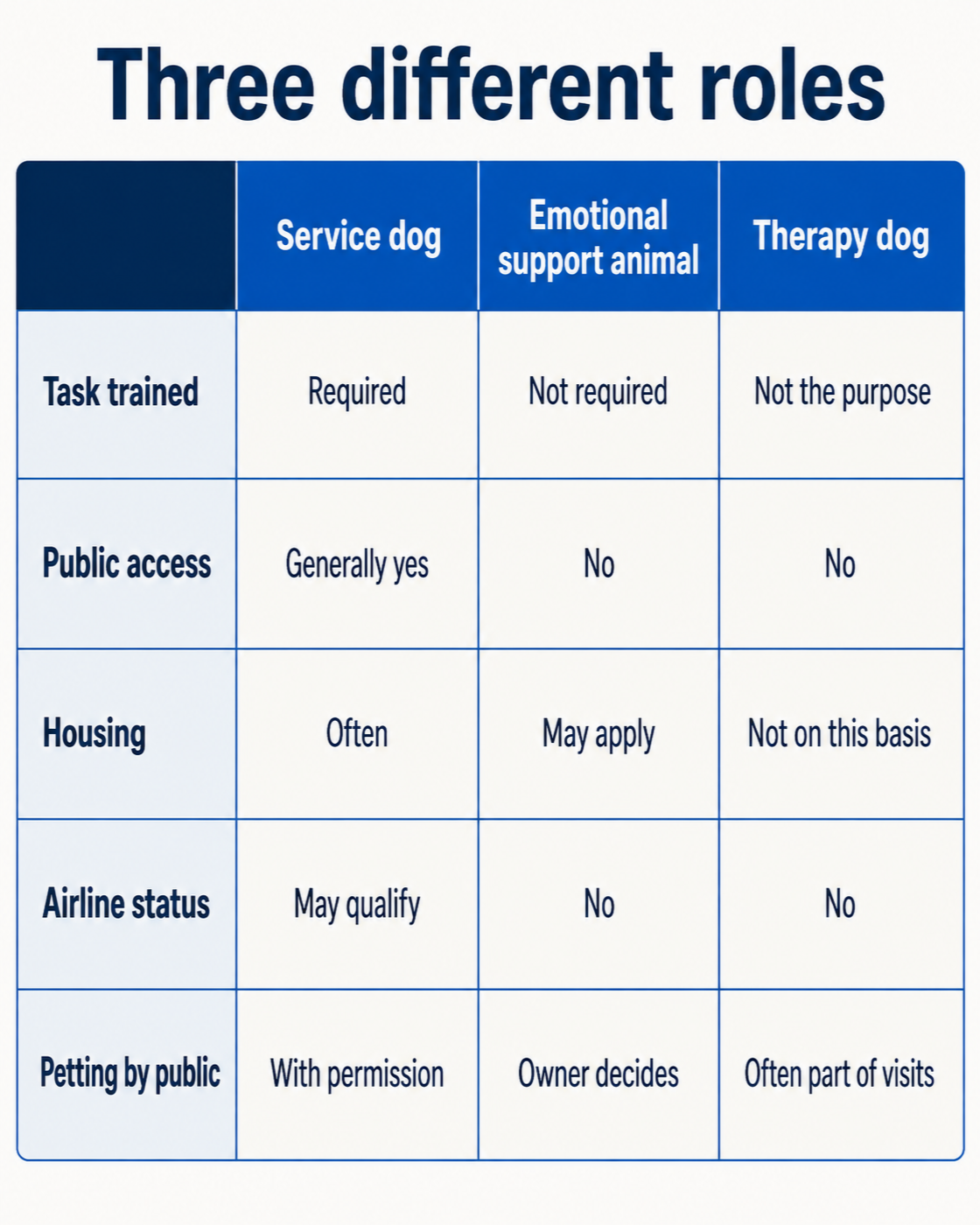
The easiest distinction is who the animal is trained or intended to help.
- A service dog performs trained work for one person with a disability.
- An emotional support animal helps one person through its presence but is not trained for disability-related tasks.
- A therapy dog and handler volunteer or work as a team to benefit other people in approved settings.
Service dogs
Under the ADA, a service animal is a dog individually trained to do work or perform tasks directly related to a person's disability.
Examples include:
- Guiding a person who is blind
- Alerting a person who is deaf
- Retrieving medication
- Responding during or after a seizure
- Alerting to a blood glucose change
- Interrupting self-harm
- Waking a person from a disability-related nightmare
Service dogs generally have access to public businesses and state or local government programs. They are not required to have a professional certification, online registration, special ID, or vest.
The handler is responsible for control and care. The dog may be removed if it is out of control and the handler does not correct it, or if it is not housebroken.
Emotional support animals
An ESA provides emotional, cognitive, or similar support that alleviates effects of a person's disability. No trained task is required.
ESA rights are mainly associated with housing accommodation law, and that area changed at the federal enforcement level in 2026. HUD announced that it would prioritize and find reasonable cause only in cases involving animals trained for disability-related assistance. Some states, including California, continue to protect qualifying ESAs under state housing law.
An ESA letter does not create access to:
- Restaurants
- Grocery stores
- Hotels
- Theaters
- Airline cabins under service animal rules
A business may voluntarily allow pets, but that is not the same as a disability access right.
Therapy dogs
Therapy dogs visit hospitals, schools, nursing homes, libraries, disaster response sites, or other programs to provide comfort and positive interaction to many people.
Therapy dog access is based on invitation or facility policy. The dog does not receive ADA public-access rights merely because it passed a therapy dog evaluation or wears a therapy vest.
Programs may require:
- Temperament testing
- Handler education
- Health and vaccination records
- Insurance
- Facility-specific training
- Recertification or reevaluation
These requirements are program standards, not proof of ADA service dog status.

Quick comparison
| Question | Service dog | Emotional support animal | Therapy dog |
|---|---|---|---|
| Who benefits? | A handler with a disability | A person with a disability | Clients, patients, students, or community members |
| Disability-related task training? | Required | Not required | Not the legal purpose |
| ADA public access? | Generally yes | No | No |
| Housing accommodation? | Often | May apply depending on law and facts | Not based on therapy status |
| Airline service animal status? | Task-trained dogs may qualify | No | No |
| Professional certification required by federal law? | No | No | A program may require evaluation |
| Can the public pet the dog? | Only with handler permission | Owner decides | Often part of structured visits |
Psychiatric service dog versus ESA
This is the most common point of confusion.
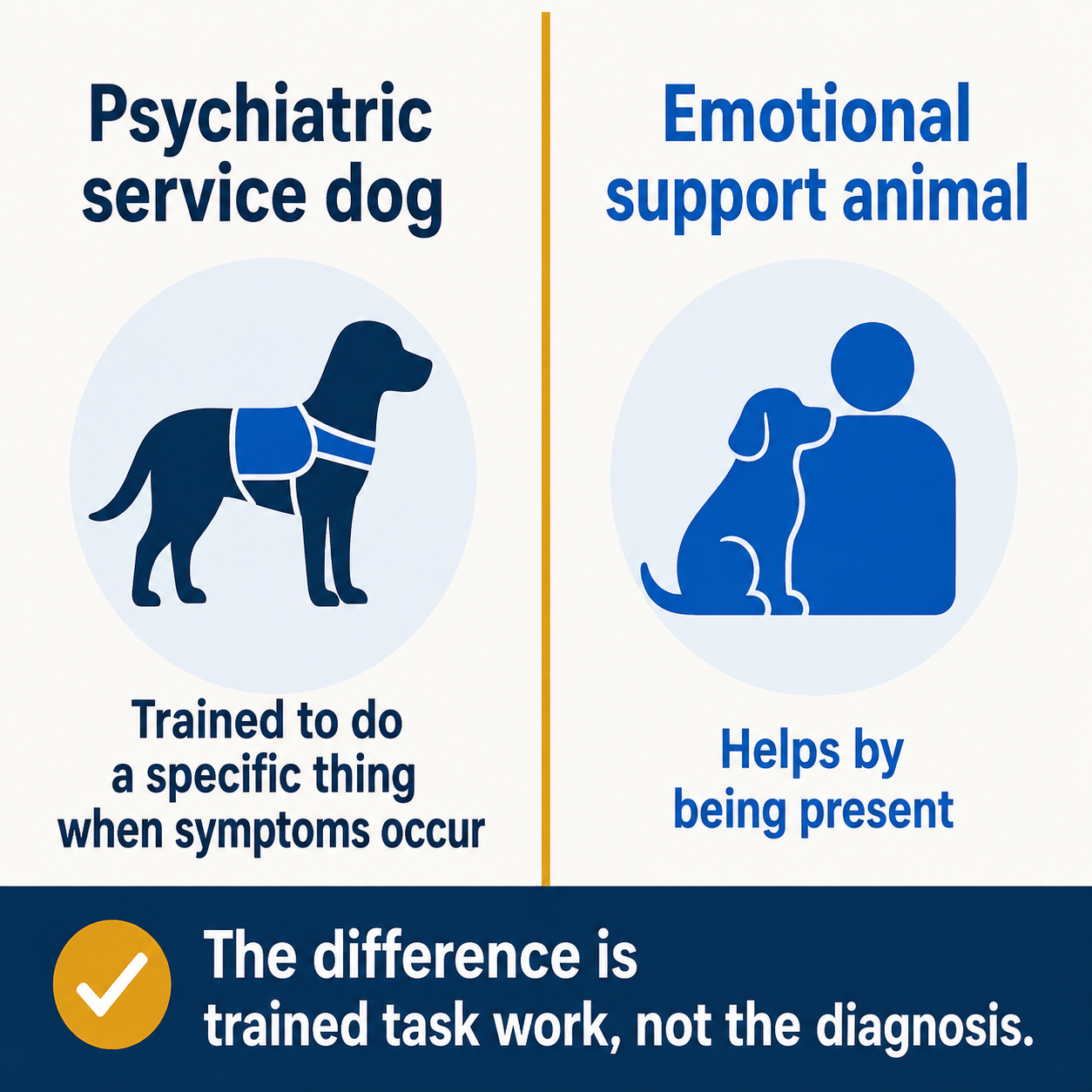
A psychiatric service dog performs trained work. A dog trained to interrupt dissociation, retrieve medication, lead a person to an exit during a disabling episode, or wake a person from a trauma nightmare may qualify.
An ESA provides benefit through presence, affection, and companionship without a trained response. The disability may be equally serious. The difference is the dog's training and function.
Does a therapist decide the category?
A therapist may evaluate a person's disability-related needs and may provide documentation for a housing or workplace request when appropriate. The therapist does not create ADA service dog status with a letter.
Likewise, a trainer can teach tasks and public behavior but cannot give a person a disability. Service animal qualification depends on the actual person, dog, training, and setting.
Sources
- U.S. Department of Justice: ADA Service Animal Requirements
- U.S. Department of Justice: Service Animal FAQs
- HUD: May 22, 2026 Animal Accommodation Enforcement Guidance
- U.S. Department of Transportation: Service Animals
Legal rights depend on the setting and current law, not the animal's vest, title, or online registration.