TASKS AND CONDITIONS
How Service Dogs Help People With Seizure Disorders
Service dogs can give some people with epilepsy or another seizure disorder practical assistance, faster access to help, and greater confidence. The most important distinction is between a response that can be deliberately trained and an advance alert that cannot be promised for every person or dog.
A seizure service dog does not treat epilepsy, prevent every injury, or replace medication and medical care. The dog's role should be one part of an individualized seizure action plan.
Seizure response versus seizure alert
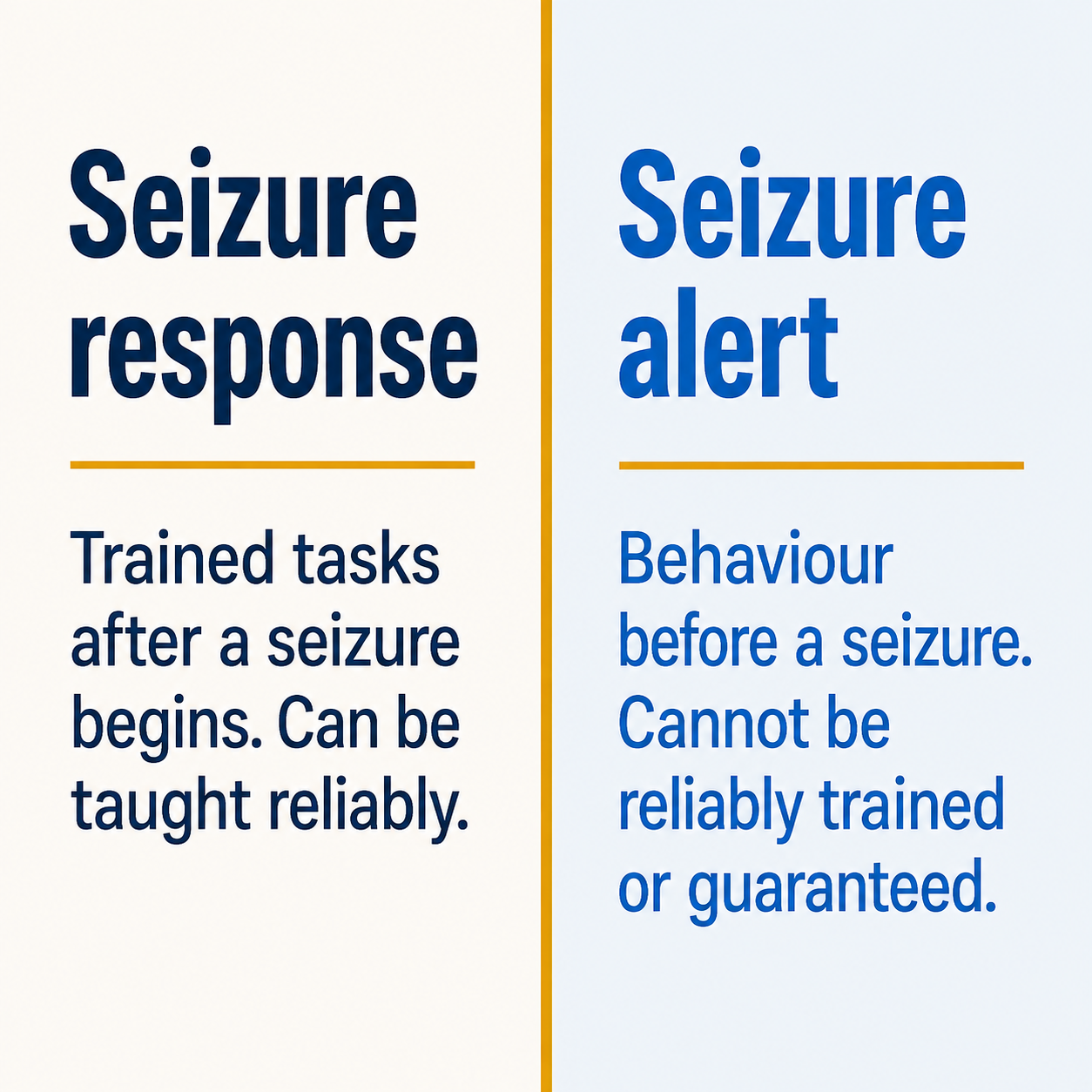
A seizure response dog is trained to take specific action during or after a seizure. These tasks can be planned, practiced, and evaluated.
A seizure alert dog is said to warn before a seizure begins. Some dogs appear to develop consistent pre-seizure behaviors, possibly in response to scent, movement, behavior, or another change. Research suggests that pre-seizure alerting may occur, but the mechanism, reliability, and generalizability remain uncertain.
No ethical trainer should guarantee that a dog will predict seizures.
Tasks a seizure response dog may perform
The right tasks depend on seizure type, the person's environment, and the recovery period.
Possible tasks include:
- Activating an emergency call button
- Barking or using another trained behavior to alert a caregiver
- Retrieving a phone
- Bringing a medication or rescue kit to the handler or caregiver
- Staying beside the person during recovery
- Leading a disoriented handler to a designated safe place
- Finding another person in the home
- Turning on a light after a nighttime seizure
- Providing a trained grounding behavior during postictal confusion
Some commonly repeated claims require caution. A dog should not be trained to restrain a person's movement, place its body where convulsive movement could injure it, or perform a task that interferes with breathing or first aid.
What a dog may notice before a seizure
Researchers have investigated whether dogs detect an odor associated with seizures. Laboratory work has found evidence of seizure-related odor cues. Other studies report spontaneous alerts in some pet dogs.

That does not mean every dog can detect every person's seizures. Seizures vary, alerts can be missed, and false alerts occur. Studies often rely on small samples, owner reports, or differing training methods.
A trainer should discuss:
- Which seizure types occur
- Whether there is a consistent observable pattern
- How alerts will be recorded and verified
- How false alerts and missed alerts will be measured
- What response tasks will remain useful even if advance alerting does not develop
Nighttime seizures
Nighttime tasks may include waking another household member, activating an alert device, staying with the handler, or retrieving a phone or rescue medication kit.
A dog is not a substitute for evidence-based seizure monitoring, a prescribed rescue medication plan, or trained human assistance. The Epilepsy Foundation notes that seizure alert devices have limitations and that no device has been proven to prevent sudden unexpected death in epilepsy.
Seizure first aid still matters
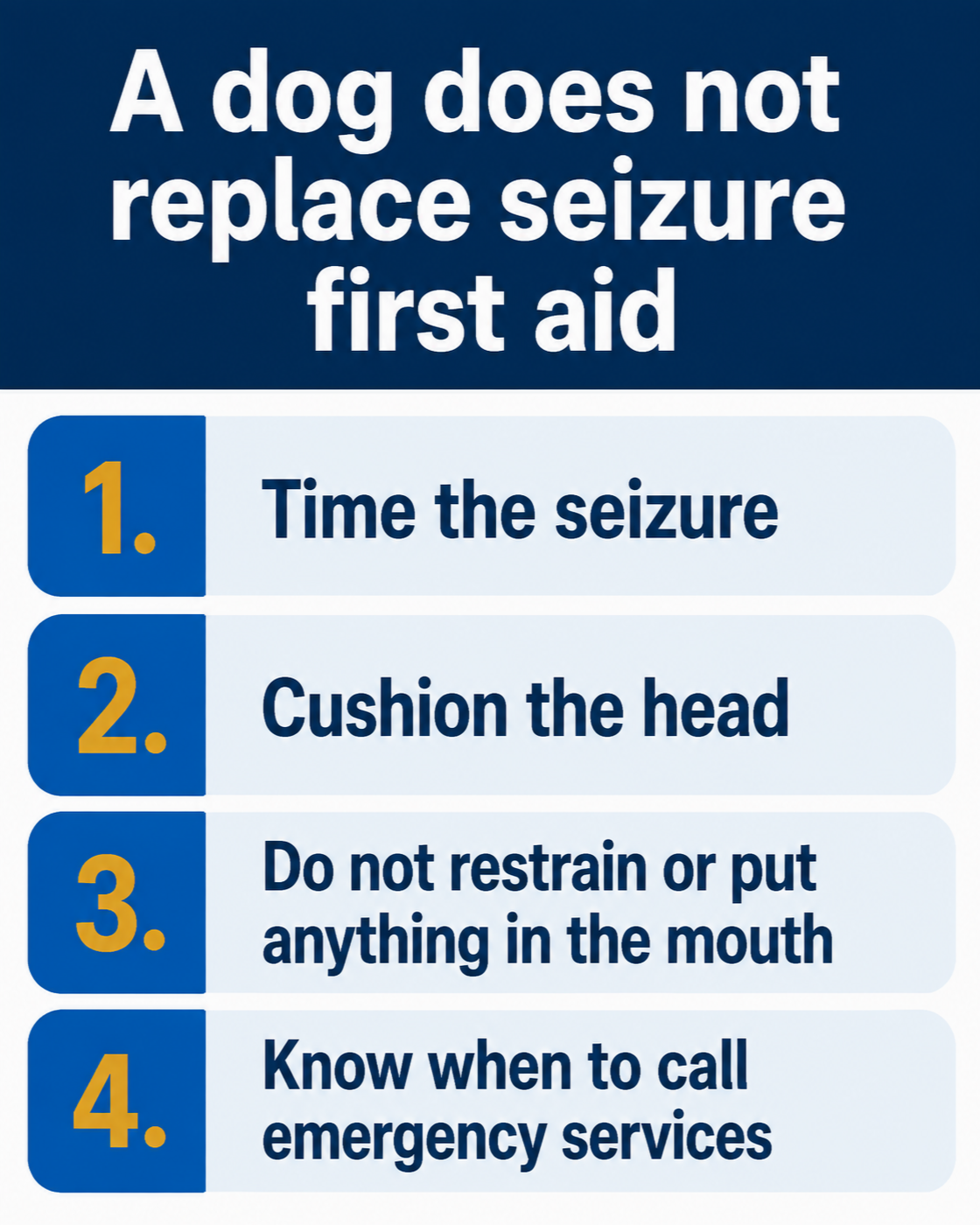
Everyone in the household should know the person's seizure action plan. General first aid includes staying with the person, protecting the person from nearby hazards, timing the seizure, and turning the person onto the side when appropriate. Do not restrain the person and do not put anything in the person's mouth.
Call emergency services according to the person's plan and accepted first aid guidance, including when a seizure lasts longer than expected, repeats without recovery, causes injury, occurs in water, or involves breathing difficulty.
The dog should be trained so that its behavior does not interfere with responders.
Who may benefit?
A seizure service dog may be worth exploring when a person:
- Has a disability related to recurrent seizures
- Has clear response tasks that a dog can perform
- Can care for and control a dog, with support if needed
- Has an environment where the tasks will be useful
- Understands that alerts cannot be guaranteed
- Can maintain medical treatment and backup safety systems
A dog may not be the best option when allergies, housing instability, cost, dog care demands, unsafe task expectations, or the person's seizure pattern make reliable work impractical.
Children and seizure service dogs
For a child, adults remain responsible for seizure first aid, medication, emergency decisions, dog handling, and animal welfare. A dog should not be represented as a replacement for supervision.
Programs should explain:
- Who will be the primary handler
- How the dog will work at school
- Who will care for the dog during a medical emergency
- How peers and staff will be taught not to distract the dog
- What happens as the child grows
School access and support should be addressed through the appropriate disability accommodation process.
Questions to ask a trainer
- Do you train response tasks, advance alerts, or both?
- What evidence supports your alert claims?
- How do you measure sensitivity, missed alerts, and false alerts?
- What happens if advance alerting never develops?
- How do you coordinate tasks with the seizure action plan?
- How do you protect the dog during a convulsive seizure?
- What follow-up support is included?
- Can I speak with clients who have similar seizure types?
The legal connection
A dog trained to respond to seizures may qualify as a service dog when the handler has a disability and the tasks are directly related to it. No federal registration or certificate is required for ADA public access.
The dog must remain under control and behave appropriately. A clinician may help describe functional needs, but a clinician's letter does not train or certify the dog.
The bottom line
The strongest case for a seizure service dog is based on reliable response tasks. Advance alerting may provide additional benefit for some teams, but it should be treated as a possible capability rather than a guaranteed medical warning system.
Sources
- Epilepsy Foundation: Seizure Dogs
- CDC: Epilepsy
- National Institute of Neurological Disorders and Stroke: Epilepsy and Seizures
- NIH: Review of Dogs Alerting or Responding to Epileptic Seizures
- NIH: Dogs and Epileptic Seizure Odor
- U.S. Department of Justice: ADA Service Animal Requirements
This article is educational and is not medical advice. A service dog should supplement, not replace, evaluation and treatment by a qualified medical professional.